
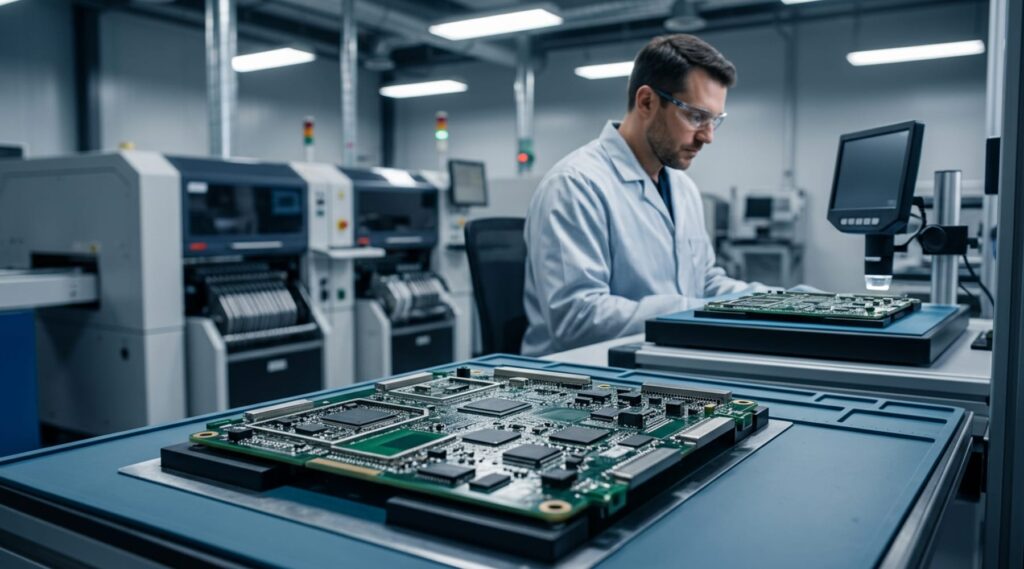
When procurement managers, engineering leaders, and operations executives evaluate electronic manufacturing services (EMS), proximity frequently emerges as an initial screening filter. Searching for a local or regional assembly partner often reflects a need for tighter control, faster turnarounds, and direct communication. For high-reliability sectors such as aerospace, medical instrumentation, industrial automation, and defense-related hardware, geographic proximity offers tangible operational conveniences. However, proximity alone does not guarantee assembly integrity.
A nearby shop may simplify travel logistics, but it cannot compensate for inadequate process controls, weak component provenance, or superficial testing depth. Critical programs demand that operational leaders separate the practical advantages of physical closeness from the hard technical qualifications that require verifiable proof. Selecting the right partner means leveraging local collaboration while holding the supplier to rigorous manufacturing and quality management standards.
The Practical Benefits of Proximity
Working with an electronics manufacturing facility within driving distance or a convenient domestic transit corridor offers clear operational efficiencies. For complex assemblies undergoing iterative refinement, physical proximity provides structural advantages that remote or offshore vendors cannot match.
- Real-Time Engineering Collaboration: Direct access between your design team and the manufacturing engineering staff minimizes the friction common in high-mix, high-consequence builds. Addressing fine-pitch component placement anomalies, thermal profile adjustments, or stack-up changes happens in real time rather than across disconnected time zones.
- Controlled Data Handling: Keeping proprietary layouts, gerber data, and firmware within a regional, domestic footprint simplifies compliance with strict data security and export control frameworks. Custodial chains for sensitive intellectual property remain visible and legally enforceable.
- Direct Facility Access and Audits: First-article inspections, pre-production line walk-throughs, and quality system audits are significantly more practical when your team can visit without extensive travel overhead. Being on-site during initial SMT runs allows your engineers to observe solder paste printing, component placement accuracy, and reflow profile stability firsthand.
- Rapid Issue Escalation: When an unexpected yield variation or component obsolescence issue arises, an escalation path involving face-to-face review prevents the communication lag that causes schedule slippage. Rapid containment and joint root-cause analyses protect delivery timelines.
Technical Qualifications That Still Require Proof
While proximity facilitates ease of doing business, it is not a substitute for technical capability. A nearby contract manufacturer must be evaluated with the same objective scrutiny applied to any global tier-one supplier. High-reliability programs require verifiable evidence across several technical competencies before awarding production.
1. Quality Management System Certifications
Accreditations must reflect current, third-party audited reality rather than historical intent. Review whether the facility maintains active certifications aligned with your specific regulatory domain, such as ISO 9001 for general quality management, AS9100 for aerospace assemblies, or ISO 13485 for medical systems. Ensure certification scopes explicitly cover printed circuit board assembly and system integration, and verify their current registration status directly through credentialing databases.
2. Process Control and Traceability
In high-reliability manufacturing, precision is maintained through controlled, repeatable processes. Inquire about the partner’s statistical process control (SPC) metrics across automated SMT placement, reflow thermal profiles, and selective soldering lines. Furthermore, evaluate component-level traceability. A disciplined manufacturing partner must be able to trace every passive, integrated circuit, and substrate batch from receiving through production lot assignment, ensuring complete accountability if a component recall occurs.
3. Inspection Depth and Test Architecture
Visual inspection under a microscope is insufficient for modern high-density interconnects and complex packaging. High-reliability work requires layered inspection infrastructure, including:
- Automated Optical Inspection (AOI): Pre- and post-reflow verification of component orientation, solder volume, and polarity.
- Automated X-Ray Inspection (AXI): Dedicated 2D or 3D X-ray systems to evaluate hidden solder joints on Ball Grid Arrays (BGAs), Quad Flat No-leads (QFNs), and bottom-terminated components for voiding, bridging, and insufficient wetting.
- Functional and In-Circuit Testing (ICT): Dedicated test fixtures, flying probe systems, or custom functional test benches that validate electrical performance before environmental testing or final pack-out.
4. Rigorous Component Sourcing Protocols
Counterfeit components and gray-market parts represent existential risks to critical electronics. Proximity does not insulate an assembler from supply chain risks. You must evaluate their supplier approval processes, their adherence to authorized distribution networks, and incoming material verification protocols. Reliable partners maintain documented procedures to detect counterfeit parts and manage component obsolescence without compromising program compliance.
5. Design for Manufacturability (DFM) Support
A true assembly partner does not simply load pick-and-place feeders based on provided CAD files. They perform detailed DFM and DFA (Design for Assembly) analyses early in the program. This process flags insufficient pad clearances, inadequate annular rings, solder mask slivers, component thermal shadowing, and spacing conflicts before tooling and fabrication begin, preventing costly respins and manufacturing delays.
6. Facility Capacity and Track Record
Evaluate whether the facility’s footprint, equipment mix, and shift structure match your volume trajectory. From prototypes to recurring medium-volume production runs, the assembler must demonstrate stable equipment calibration routines, adequate floor capacity, and a verifiable history of program longevity. Request documented yield metrics and on-time delivery histories for assemblies of similar complexity.
A Checklist for Opening Production Conversations
Before committing to a regional PCB assembly partner, structure your discovery discussions around objective criteria. Use the following checklist to evaluate capabilities during your initial facility audit or technical discovery meeting:
- Quality Baseline: Are quality certifications (ISO 9001, AS9100D, ISO 13485) current, certified by recognized registrars, and supported by documented internal audit schedules?
- Inspection Systems: What specific optical and X-ray inspection equipment is used on the production floor, and how are inspection thresholds calibrated for IPC Class 2 or Class 3 acceptance criteria?
- Traceability Systems: Can the provider demonstrate lot-level or serial-level traceability back to specific reel, date, and lot codes?
- Supply Chain Controls: Does the purchasing department source exclusively through manufacturer-authorized channels, and what testing is applied to spot-buy or non-franchised parts when allocations require it?
- Engineering Engagement: Will your technical team have direct access to line and process engineers during DFM reviews, prototype builds, and production ramp?
- Change Management: What formal engineering change order (ECO) and deviation request processes are used to govern layout revisions and component alternates?
Moving Forward with Technical Due Diligence
Selecting an assembly partner for mission-critical electronics requires balancing the operational speed of domestic collaboration with strict, verifiable manufacturing discipline. While having a facility within reach accelerates troubleshooting and streamlines program oversight, production success ultimately rests on audited processes, robust test depth, and systematic quality controls.
American Precision Electronics operates a dedicated 30,000-square-foot manufacturing facility in Illinois, providing OEM partners with rigorous, domestic manufacturing oversight and advanced PCB assembly capabilities. We invite your engineering and procurement teams to connect with our technical staff to discuss your upcoming design specifications, quality requirements, and production schedules.