
Beyond the Certificate: Evaluating Cable Harness Integrity
For OEM procurement leaders, quality managers, and systems engineers, sourcing custom cable harnesses involves significant technical risk. A single intermittent crimp, poor pin retention, or degraded insulation jacket can compromise an entire mission-critical system. When reviewing prospective manufacturing partners, teams frequently encounter vendor presentations laden with quality logos, ISO registrations, and industry acronyms. However, possessing quality certifications is merely a baseline qualification. It does not provide definitive proof of daily process discipline.
High-reliability applications demand that buyers evaluate verifiable evidence of process control rather than relying solely on a certificate on a wall. To mitigate field failures, avoid costly rework, and maintain schedule predictability, OEM evaluators must know how to inspect the operational mechanics behind the standards. This guide covers how to assess workmanship criteria, operator qualifications, inspection regimens, electrical testing, and full traceability across custom cable harness production. Teams beginning this process can discuss supplier qualification with APE.
Distinguishing Certifications, Standards, Registrations, and Customer Requirements
Quality assessments often stumble over terminology. Conflating management standards with workmanship specifications obscures whether a supplier can build your design reliably. Technical buyers should separate these evaluation categories:
- Quality Registrations (e.g., ISO 9001, AS9100D, ISO 13485): These audit the organizational Quality Management System (QMS). They verify that a supplier documents procedures, manages risks, tracks nonconformances, and operates continuous improvement frameworks. A registration demonstrates administrative control, but it does not specify how crimps are executed or how harnesses are tested.
- Workmanship Standards (e.g., IPC/WHMA-A-620): These define the technical acceptance criteria for cable and wire harness assemblies. They detail physical parameters for Class 1 (General Electronic), Class 2 (Dedicated Service), and Class 3 (High Performance / Harsh Environment) builds, covering stripping, crimping, soldering, ultrasonic welding, shielding, and marking.
- Product Safety Certifications (e.g., UL, CSA): These verify that specific cable constructions and component materials meet flammability, thermal, and electrical safety thresholds under defined operating limits.
- Customer-Specific Requirements (CSRs): These represent your unique drawings, proprietary test procedures, customer engineering specifications, and packaging mandates. Outstanding contract manufacturers translate your CSRs into standard operating work instructions rather than treating them as disconnected addenda.
Assessing Workmanship Standards and Acceptance Criteria
Specifying IPC/WHMA-A-620 on a drawing is straightforward; verifying that the shop floor manufactures to that standard requires deeper investigation. Class 3 requirements mandate rigorous mechanical and electrical margins, especially for terminal crimping and connector termination.
During vendor assessments, evaluate how the manufacturer defines, inspects, and documents terminal crimp integrity. Mechanical crimping is a science governed by conductor deformation, compression ratios, and pull force limits. A reliable manufacturer should demonstrate routine cross-section analysis (microsectioning) during setup alongside mechanical pull testing.
Evaluation questions to ask:
- Do your travelers and digital work instructions explicitly state the required IPC class for every assembly step?
- What terminal crimp height and width tolerances do you monitor, and are tool settings verified at the start of every shift?
- Can you provide destructive pull-force test records and microsection micrographs for recent production runs using our specified wire gauges and contact types?
Operator Qualification and Ongoing Competency
Cable harness manufacturing involves dedicated manual operations. Automated wire stripping and crimping equipment provides consistency, but routing, shielding, connector pinning, backshell assembly, and overmolding depend heavily on human technique. Therefore, operator qualification is a critical risk factor.
Suppliers must show more than a training log. Look for an active, structured competency program led by certified trainers (such as IPC Certified IPC Trainers or CITs) who qualify assembly operators and inspection staff (Certified IPC Specialists or CIS). Furthermore, evaluate how the supplier manages skills requalification when operators have been away from specific assembly tasks or when engineering changes introduce new tooling. For help evaluating these records against program expectations, request a documentation review.
Evidence buyers should request:
- The supplier’s training matrix showing current IPC/WHMA-A-620 certifications and recertification intervals for both production operators and quality control personnel.
- Documented procedures for onboarding operators onto specialized operations like semi-automatic crimping, coax termination, or micro-miniature soldering.
- Records of remedial training or internal audits triggered by workmanship nonconformances.
In-Process Verifications vs. Final Inspection
Inspection cannot inspect quality into a product; it only catches defects after costs have been incurred. High-reliability manufacturing prioritizes preventative in-process verifications so defects are stopped at the source before potting, heat shrinking, or overmolding permanently seals the harness interior.
Examine the supplier’s Quality Control Plan (QCP). Stripping inspections should verify that wire strands are neither cut nor nicked, and insulation crimps must demonstrate correct wrap without puncturing outer jackets. Intermediate inspections must confirm pin depth, contact engagement, and keying prior to backshell torquing. Once a connector is locked and sealed, confirming terminal insertion depth visually becomes impossible.
Evaluation questions to ask:
- Where are your physical quality gates positioned along the assembly line?
- What calibrated tools (go/no-go pin gauges, digital optical comparators, contact insertion/extraction force tools) are stationed directly at operator work cells?
- How are in-process defects isolated, logged, and reviewed through root cause corrective action (RCCA) workflows?
Electrical Testing Regimens: Continuity, DWV, and Insulation Resistance
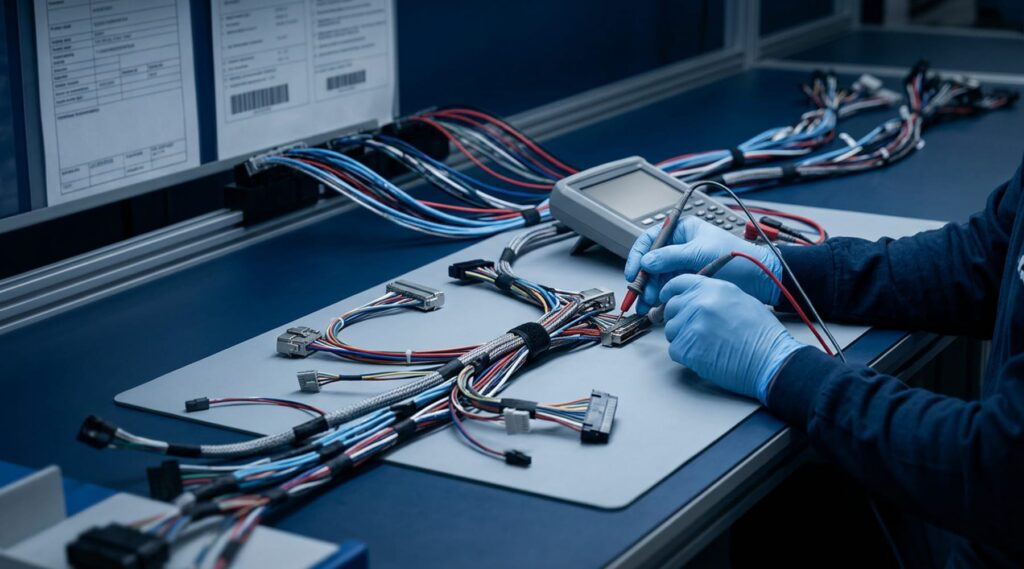
Visual inspection confirms mechanical form, but electrical testing validates performance. A cable harness may look immaculate while harboring crossed wires, high-resistance crimps, or microscopic dielectric breakdown paths that fail under operational stress. Contract manufacturers should use programmable, automated cable testers to validate each assembly against netlists extracted directly from engineering schematics. OEM teams can discuss electrical testing requirements with APE before finalizing a validation plan.
Ensure the supplier supports the full spectrum of required electrical verifications:
- Continuity and Resistance: Verifying point-to-point pinout routing and measuring low-resistance thresholds across conductors to catch cold solder joints or damaged wire strands.
- Dielectric Withstanding Voltage (DWV / Hi-Pot): Subjecting adjacent conductors and connector shells to high voltage to verify dielectric integrity and rule out arcing.
- Insulation Resistance (IR): Measuring leakage current under elevated DC voltages (often 500V or 1000V) to confirm insulation resistance meets megaohm or gigaohm thresholds.
- Component Validation: Verifying inline resistors, diodes, capacitors, or shielding terminations embedded within the harness architecture.
Evidence buyers should request:
- Automated test logs linking serial-numbered harness assemblies to specific test profiles, operator IDs, and quantitative test outputs.
- Documentation confirming that test fixtures and mating interfaces are checked for wear, pin deflection, and contact resistance on a planned calibration schedule.
Material Traceability, Lot Control, and Change Management
When an issue surfaces in production or during deployment, robust traceability limits your recall scope from hundreds of units down to a distinct batch. Cable harness suppliers must maintain end-to-end traceability connecting raw materials to finished builds. This includes wire spools, contact pins, connector bodies, backshells, solder lots, flux, and shrink tubing.
Traceability also hinges on disciplined change control. An unnotified tooling alteration, vendor substitution of equivalent wire, or minor change in heat-gun nozzle temperature can fundamentally alter product reliability. Ensure your manufacturing partner has a rigorous Engineering Change Order (ECO) system that enforces drawing rev-level tracking, secures tooling configuration, and requires customer approval prior to process modifications.
Evaluation questions to ask:
- How does your Enterprise Resource Planning (ERP) or Manufacturing Execution System (MES) tie specific component lot codes and Certificates of Conformance (CoCs) to an individual harness serial number?
- What internal safeguards prevent obsolete drawings or outdated traveler instructions from reaching active workstations?
- Can you walk our team through a mock trace exercise to show how quickly you can locate all assemblies built with a suspect reel of wire or lot of crimp contacts?
Supplier Evaluation Checklist for Cable Harness Programs
Selecting a manufacturing partner requires looking past marketing promises and auditing objective records. Use this checklist during your next vendor survey or on-site audit:
- Workmanship Evidence: Verified crimp cross-sections, certified pull-tester logs, and clear alignment with IPC/WHMA-A-620 Class 2 or 3 criteria.
- Personnel Verification: Current trainer and specialist credentials with clearly documented training intervals and skills matrices.
- Preventative Quality Gates: Calibrated in-process inspection tools stationed at critical assembly steps before irreversible operations.
- Automated Electrical Screening: Dedicated test adapters, netlist-driven automated continuity, Hi-Pot, and IR test capabilities with archived digital logs.
- Traceability Systems: Lot-tracked components, serialized product marking, and a transparent change control workflow.
Aligning Process Control with Program Reliability
Quality cable harness manufacturing relies on systematic, transparent, and verifiable control at every stage of the assembly process. Certifications demonstrate that an organization has built a foundation for quality management, but disciplined shop-floor execution ensures that your custom wiring assemblies perform reliably in the field.
By shifting supplier evaluations from superficial certificate reviews to rigorous assessments of operator competency, crimp verification, automated electrical testing, and lot traceability, OEM teams protect their programs from preventable risk. Partnering with a domestic manufacturing team that embraces process transparency, open communication, and detailed quality documentation gives you the confidence that every assembly matches your design intent. To align drawings, acceptance criteria, volumes, and documentation needs, review your cable harness program requirements with APE.