
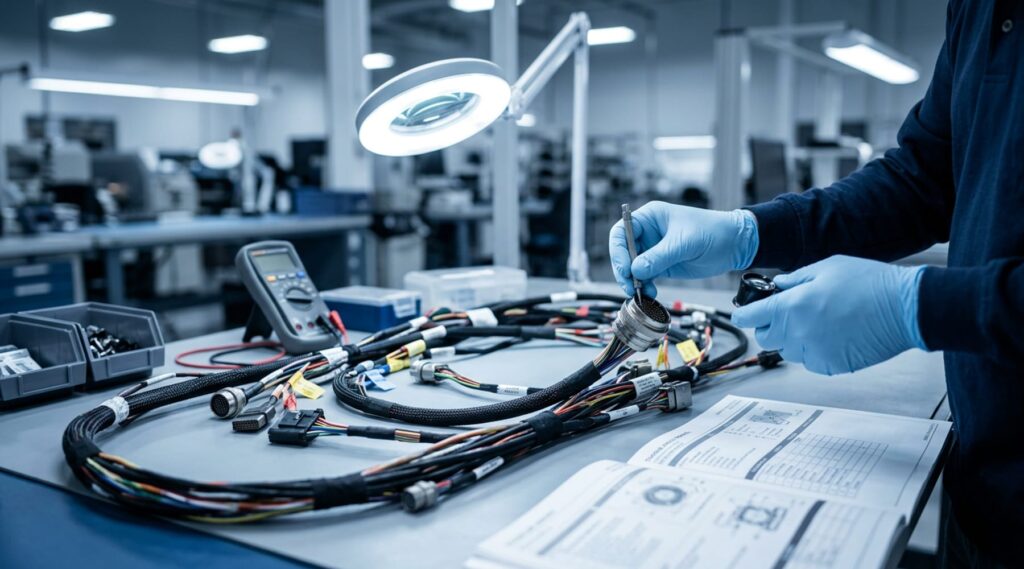
In mission-critical aerospace and defense systems, the cable harness is the central nervous system connecting ruggedized computing, power distribution, and precision sensors. While procurement teams often focus intense scrutiny on bare printed circuit boards and active semiconductor devices, the physical interconnect layer remains one of the primary points of mechanical and electrical failure under field stress. Selecting a manufacturing supplier requires looking far beyond basic assembly labor; it demands a systematic evaluation of process control, materials authentication, and engineering rigor.
For sourcing leaders, bridging the gap between design engineering and physical hardware deployment requires an onshore manufacturing ally capable of handling high-mix, high-consequence requirements. This technical evaluation guide outlines the critical operational benchmarks defense and aerospace sourcing teams must evaluate when qualifying a domestic cable harness manufacturing partner.
1. Workmanship Standards and Operator Certifications
Aerospace and defense programs cannot tolerate variability in crimp compression, shield termination, or soldering. When auditing prospective suppliers, review their formal alignment with industry-recognized workmanship standards:
- IPC/WHMA-A-620 Requirements: Ensure the facility actively trains, tests, and certifies operators and quality inspectors to Class 3 standards for high-performance and severe-environment electronic products. Inquire whether they maintain an in-house Certified IPC Trainer (CIT) to preserve assembly standard uniformity.
- Crimp Integrity Benchmarking: High-reliability applications demand objective proof of crimp quality. Sourcing teams should audit cross-sectional analysis procedures, terminal pull-force validation data, and crimp height verification routines logged prior to every production shift.
- Soldering Discipline: For assemblies requiring solder cup connectors or board-to-cable terminations, confirm operator adherence to J-STD-001 with Space/Defense addenda where applicable.
2. Wire, Contact, and Connector Traceability
Supply chain integrity directly impacts program mission readiness. A domestic harness partner must demonstrate a closed-loop traceability framework that prevents the introduction of counterfeit or non-compliant raw materials:
- Lot and Heat Traceability: Sourcing teams must verify that raw bulk wire, heat-shrink tubing, backshells, contacts, and military-standard circular connectors are completely traceable back to the original manufacturer lot number and Certificate of Conformance (CoC).
- Authorized Sourcing Channels: Evaluate whether the supplier maintains strict distributor qualification policies to mitigate the risks associated with unauthorized broker markets.
- Material Storage Discipline: Specialized components, including heat-shrinkable soldersleeves, adhesives, and pre-mixed potting epoxies, require active shelf-life tracking and controlled temperature storage to preserve design performance.
3. Electrical and Mechanical Test Methodologies
Visual inspection alone cannot verify high-consequence interconnect reliability. A capable cable harness partner integrates automated electrical testing alongside destructive and non-destructive physical validation steps:
- Automated Continuity and Resistance Testing: Confirm the supplier utilizes programmable cable analyzers to detect micro-shorts, high-resistance connections, and miswires with high-voltage DC isolation (dielectric breakdown) capability.
- Hi-Pot and Insulation Resistance (IR): Defense harnesses operating under high voltages or harsh environmental conditions demand Hi-Pot testing to identify marginal dielectric insulation before deployment.
- Mechanical Verification: The evaluation should review calibrated pull-force testers for crimp retention validation, contact insertion and retention gauges, and bend-radius inspection fixtures.
- Environmental and Seal Testing: For overmolded or potted harsh-environment harnesses, verify testing protocols for water-ingress protection (IP-rated sealing) and backshell torque consistency.
4. Production Documentation and Quality Records
Aerospace and defense contracts require full documentation fidelity. Sourcing teams need transparent access to quality artifacts throughout the program lifecycle:
- Detailed Work Instructions: Look for digital or travel-bound visual work instructions that illustrate pinout mapping, color coding, wire routing, and stripping specifications for every station.
- First Article Inspection (FAI): The supplier should possess the administrative and quality infrastructure to execute complete AS9102 First Article Inspection reports, validating dimensional tolerances and engineering drawing compliance.
- Inspection Evidence Retention: Verify standard data retention periods for calibrated test data, electrical test logs, and operator stamps to ensure your organization remains audit-ready during customer or government reviews.
5. Engineering Change Order (ECO) Control
Aerospace platforms frequently undergo revisions across their service life. A supplier’s engineering change control system is a direct indicator of overall operational maturity:
- Formal Revision Control: The partner must use a centralized configuration management system ensuring that production lines immediately pull superseded traveler documents and drawings when an ECO is issued.
- Material Purge Protocols: Confirm how the partner identifies, isolates, and discards or reworks work-in-progress (WIP) and existing floor stock when drawing revisions occur.
- Design for Manufacturability (DFM) Feedback: A responsive domestic partner reviews schematic revisions and provides early feedback on tooling limitations, bend radii constraints, or component lead times before full assembly runs begin.
6. Integration Capability with Broader Electronic Manufacturing
Harnesses rarely operate in isolation. They integrate directly into printed circuit board assemblies, card cages, and structural enclosures. Partnering with a supplier that maintains comprehensive electronic manufacturing services (EMS) simplifies procurement and prevents cross-vendor finger-pointing:
- Box-Build and Higher-Level Assembly (HLA): Sourcing from a partner that integrates cable routing directly into PCB enclosures ensures functional alignment between the harness, mating headers, and chassis grounding points.
- Unified Testing Architecture: When the harness fabricator also understands PCBA testing, functional testing can encompass the entire operational system, validating system-level performance prior to delivery.
- Streamlined Vendor Base: Consolidating your electro-mechanical supply chain reduces management overhead, coordinates lead times, and unifies quality accountability under one roof.
Supplier-Evaluation Checklist for Sourcing Teams
Use this practical checklist during initial capability audits and site visits:
- [ ] Does the partner maintain an active, verifiable quality management system aligned with high-reliability electronics?
- [ ] Are crimp tools calibrated on regular intervals with automated shut-off mechanisms when cycle parameters are missed?
- [ ] Can the partner supply complete 100% test logs and AS9102 FAI documentation upon request?
- [ ] Is intellectual property protected through secure, domestic IT infrastructure and controlled facility access?
- [ ] Does the company possess on-site automated testing equipment tailored to high-density, multi-pin harnesses?
- [ ] Are procedures in place to securely manage engineering changes without contaminating live production lots?
- [ ] Does the engineering team offer proactive DFM support to reduce assembly cycle time and material bottlenecks?
Securing High-Reliability Interconnects
Choosing a domestic cable harness partner is fundamentally an exercise in risk mitigation. For defense and aerospace sourcing professionals, the ideal partner provides the precision tooling and quality controls of a large manufacturer alongside the open communication, responsiveness, and accountability of a dedicated domestic facility. By prioritizing verified workmanship standards, absolute material traceability, documented change control, and system-level integration, procurement teams protect program schedules and field reliability. Contact American Precision Electronics today to discuss your cable harness specifications and review our domestic manufacturing capabilities.