
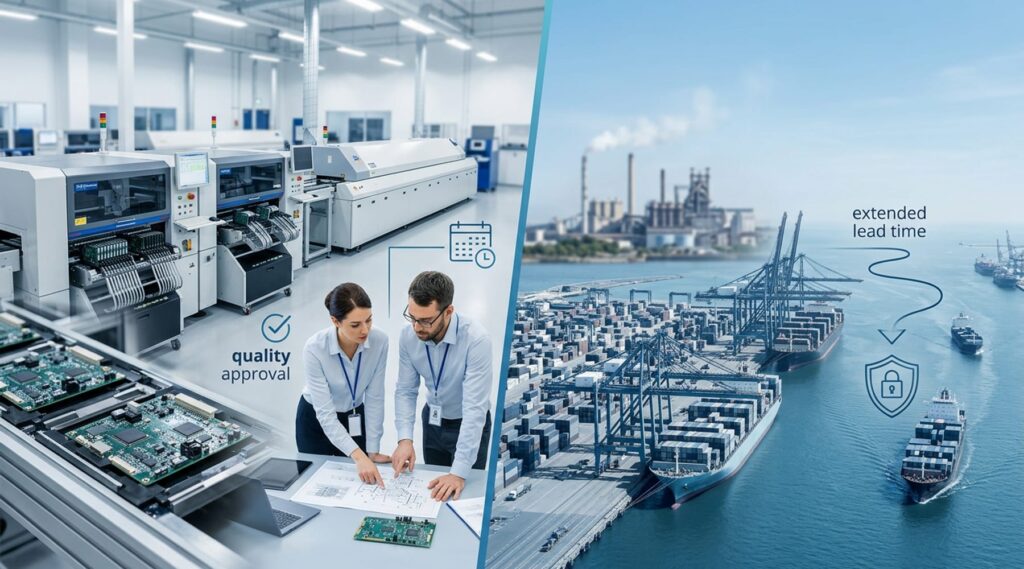
Balancing Cost, Control, and Reliability in PCB Assembly
For procurement, engineering, and operations leaders managing mission-critical electronics, choosing an electronics manufacturing services (EMS) partner is one of the most consequential decisions in a product lifecycle. On paper, the unit-price advantages of offshore high-volume manufacturing facilities can appear compelling. Yet across complex sectors such as aerospace, medical instrumentation, industrial automation, and automotive electronics, total cost of ownership encompasses far more than bill of materials line items.
When programs encounter unexpected schedule slippage, intellectual property exposure, or latent manufacturing defects, the margins gained on unit costs can vanish quickly. Evaluating domestic versus offshore production requires a rigorous, technical examination of operational variables: lead-time exposure, intellectual property custodial chains, quality escalation timelines, engineering change management, and long-term continuity.
Lead-Time Volatility and Transit Exposure
Logistical lead time in offshore production introduces structural volatility that static forecasting rarely captures. While nominal transit times may be quoted at three to four weeks for ocean freight or five business days for international air, real-world supply chains regularly encounter port congestion, customs clearance inspections, seasonal freight capacity crunches, and geopolitical trade adjustments.
- Inventory Buffer Burdens: To absorb transportation variances, procurement teams must maintain larger safety stock volumes on domestic soil. This ties up working capital and inflates carrying costs.
- Carrying Costs vs. Agility: Extended supply pipelines limit responsiveness to sudden demand shifts, leaving OEMs vulnerable to either costly stockouts or rapid obsolescence if demand drops.
- Domestic Transit Predictability: A domestic partner operates within a unified regional logistics network. Ground transportation and domestic air shipments offer predictable, trackable delivery windows measured in hours or days rather than weeks, dramatically reducing inventory holding requirements.
Intellectual Property Control and Data Integrity
Protecting proprietary circuit layouts, firmware images, and fabrication documentation requires strict custodial governance. When manufacturing files leave domestic jurisdiction, legal recourse becomes complex, expensive, and often ineffective under foreign civil legal frameworks.
- Firmware Security: Uploading secure bootloaders, encryption keys, and proprietary binaries during production requires audited network infrastructure and trusted technician access controls.
- Documentation Dispersion: Comprehensive build packages containing Gerber files, schematics, and testing criteria can easily be duplicated or accessed outside agreed contractual parameters once distributed across multiple foreign sub-tier vendors.
- Regulatory and Contractual Compliance: High-reliability applications often require strict compliance with regulatory frameworks and security controls that prohibit unauthorized foreign access. Domestic EMS providers operate directly under enforceable national commercial laws, maintaining a verifiable custodial chain for all digital assets.
Quality Escalation and Defect Containment
In high-reliability manufacturing, zero-defect production is maintained as a core quality objective and system standard. Achieving this standard requires immediate, transparent escalation workflows whenever non-conformances emerge on the assembly line.
When quality escapes occur in an offshore environment, the physical and temporal distance impairs corrective action. If a marginal solder joint or component placement defect goes unnoticed until end-of-line functional test or incoming inspection at your facility, hundreds or thousands of assemblies may already be in transit. Quarantining, returning, and reworking those units creates massive logistical bottlenecks and warranty exposure.
Conversely, working with a domestic EMS facility allows for real-time containment. Engineering teams can participate in direct root-cause failure analysis, review automated optical inspection (AOI) and X-ray data alongside manufacturing engineers, and implement corrective actions within the same shift. The ability to conduct on-site physical audits without international travel barriers ensures that quality management systems operate with complete visibility.
Engineering Change Order (ECO) Communication
Iterative engineering is a baseline reality for complex electronic hardware. Component end-of-life notices, design revisions, and firmware optimizations demand frequent Engineering Change Orders. The success of an ECO depends heavily on real-time feedback loops between design engineers and production technicians.
- Time-Zone Latency: A 12-hour time difference turns simple clarification questions regarding component pinouts or solder mask relief into multi-day email exchanges, stalling the line.
- Design for Manufacturability (DFM) Feedback: Domestic partners enable immediate design for manufacturability reviews where manufacturing engineers and OEM layout teams collaborate directly on panelization, thermal relief, and assembly tolerances.
- Scrap Mitigation: Direct communication ensures that running revisions cut into active production immediately, preventing the accidental fabrication of obsolete revisions.
Supply Chain Continuity and Lifecycle Management
Managing component obsolescence and counterfeit risks requires verifiable, transparent supply chains. Domestic EMS providers leverage authorized distribution channels and established counterfeit-mitigation protocols under recognized quality standards and certification frameworks like AS9100D and ISO 9001. Traceability documentation, lot tracking, and material certifications remain accessible and auditable throughout the multi-year lifecycles common in industrial, aerospace, and medical sectors.
Strategic Decision Matrix: Domestic vs. Offshore EMS
Selecting the right production model requires matching your technical specifications, regulatory footprint, and operational goals against supplier capabilities. Use the following criteria to evaluate where your assemblies align best:
| Evaluation Criteria | Offshore Model | Domestic Model | Hybrid Approach |
|---|---|---|---|
| Production Volume & Mix | High volume, low product mix with mature design stability. | High mix, low-to-medium volume requiring rapid changeovers. | Domestic pilot runs transitioning to offshore for mature volumes. |
| Design Stability & ECO Frequency | Stable designs with minimal expected revisions. | Active product development with frequent revisions and updates. | Domestic prototyping followed by offshore production freezes. |
| IP Sensitivity & Security | Standard consumer electronics with public architectures. | Proprietary architectures, mission-critical logic, defense data. | Domestic programming/final box build; offshore sub-assembly. |
| Quality Standards & Traceability | Commercial commercial-grade testing; standard warranties. | Rigorous lot-traceability, AS9100D/ISO 9001 compliance standards. | Offshore component sourcing with domestic screening and test. |
| Logistics & Lead-Time Tolerance | Long planning horizons capable of handling 6-12 week shifts. | Tight deployment schedules demanding just-in-time delivery. | Domestic safety stock balancing offshore production pipelines. |
Choosing the Right Manufacturing Footprint
Neither domestic nor offshore manufacturing is universally superior; each serves distinct stages of product maturity and market demands. For high-volume consumer goods where bill of materials cost is the sole operational driver and designs rarely change, offshore facilities offer undeniable scale.
However, when programs demand high reliability, rigorous intellectual property security, and collaborative engineering support, evaluating the right domestic manufacturing partner can help identify opportunities for lower total landed costs and substantially less risk. Furthermore, many organizations adopt a hybrid approach: developing prototypes, managing initial market introductions, and establishing quality benchmarks domestically before selectively offloading commoditized elements overseas.
Conclusion
Assessing an electronics manufacturing partner requires looking beyond upfront quotes and evaluating how speed, security, and technical precision impact your bottom line. By proactively mitigating lead-time volatility, protecting proprietary designs, and establishing responsive engineering loops, OEMs protect both their balance sheets and brand reputations.
American Precision Electronics provides dependable, high-precision PCB assembly and manufacturing services tailored to mission-critical applications. Contact our technical team today to discuss your manufacturing specifications and discover how our domestic capabilities can support your upcoming programs.