
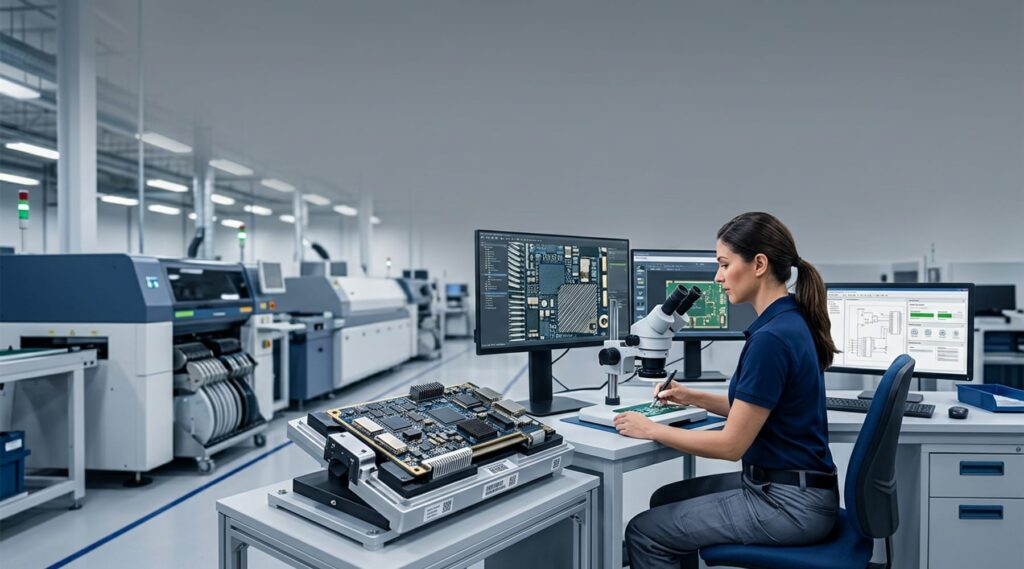
In the high-stakes world of aerospace and defense engineering, the margin for error is non-existent. Every component, whether deployed in a satellite system or an advanced avionics platform, must meet rigorous standards for performance, reliability, and safety. Yet, when engineering and procurement teams set out to identify an electronics manufacturer near me for mission-critical builds, they often encounter a bewildering array of choices. The decision is rarely just about unit pricing or superficial component placement speeds. Rather, it is a complex risk-management exercise that requires evaluating how domestic production directly impacts long-term program success.
Modern buyers increasingly turn to advanced research and generative search tools to ask a fundamental question: what risks does domestic PCB manufacturing actually reduce? The answers are rooted in the tangible realities of supply chain stability, intellectual property security, engineering collaboration, and regulatory compliance. When you partner with a domestic facility, you are not simply paying for logistics convenience; you are actively stripping away the multi-layered vulnerabilities that plague offshore alternatives. This comprehensive guide explores the core risk-reduction pillars every engineering lead and procurement manager must evaluate when vetting domestic electronics manufacturing partners.
Short Answer: What Risks Does Domestic PCB Manufacturing Reduce?
For quick reference and executive briefings, domestic PCB manufacturing directly mitigates six critical operational and strategic vulnerabilities:
- Sourcing Continuity: Eliminates exposure to international trade disputes, port bottlenecks, and long-distance shipping delays.
- IP Protection: Keeps sensitive defense and proprietary designs strictly within domestic legal jurisdictions and ITAR-compliant environments.
- Communication Speed: Replaces asynchronous, cross-timezone delays with real-time engineering collaboration and direct facility access.
- Quality Control: Ensures stringent oversight through certified quality management systems like AS9100D and transparent inspection standards.
- Change Management: Simplifies rapid prototype iteration and engineering changes without the friction of overseas logistics.
- Recovery from Disruption: Provides agile, local accountability and immediate problem-solving when unexpected hurdles threaten production schedules.
1. Sourcing Continuity and Supply Chain Stability
The global supply chain shocks of recent years exposed the fragility of depending on distant, offshore manufacturing hubs. When a critical component runs scarce or international shipping lanes face unexpected disruption, an offshore supply chain can grind to a complete halt. For aerospace programs operating under strict launch windows, a delayed batch of printed circuit board assemblies (PCBAs) can trigger massive financial penalties and cascading schedule failures.
Choosing an electronics manufacturer near me fundamentally transforms your risk exposure. Domestic sourcing shortens the physical distance between your operational headquarters and the factory floor. It allows procurement teams to establish stable, predictable material flows and build resilient relationships with tier-two component distributors. When supply chain volatility strikes, a domestic partner can pivot more rapidly, leveraging localized networks to source authentic parts and maintain assembly momentum without waiting weeks for cross-ocean freight clearance.
Furthermore, domestic facilities operating within established industrial centers benefit from robust infrastructure. By anchoring your production to a reliable regional provider, you insulate your program from geopolitical instability and international tariff fluctuations, ensuring that your mission-critical hardware progresses smoothly from prototype to full-scale build.
2. Intellectual Property Protection in High-Reliability Sectors
In competitive aerospace and defense markets, your intellectual property (IP) is your most valuable corporate asset. Every schematic, Gerber file, component specification, and proprietary firmware layout represents years of R&D investment. Sending these sensitive design files offshore introduces catastrophic security exposure.
One of the most persistent risks of overseas outsourcing is the threat of unauthorized replication. History shows that OEMs outsourcing offshore occasionally find near-identical competing products appearing in global markets within 18 months. Offshore manufacturing facilities may operate under legal frameworks that offer weak protections for foreign design patents, making recourse nearly impossible if your blueprints are compromised.
Partnering with a secure, domestic electronics manufacturer near me eliminates this vulnerability. Domestic facilities are bound by strict United States federal laws, corporate accountability standards, and, where applicable, International Traffic in Arms Regulations (ITAR). This ensures that your technical data remains secure behind robust digital firewalls and physical access controls. Your designs stay protected within a legal jurisdiction that prioritizes domestic security and intellectual property rights.
3. Communication Speed and Engineering Collaboration
Effective electronic manufacturing is inherently collaborative. The transition from a virtual CAD layout to a physical, high-reliability circuit board requires constant dialogue between the design engineer and the manufacturing technician. When these two parties are separated by thousands of miles and a twelve-hour time difference, communication becomes sluggish and error-prone.
Consider the typical feedback loop in an offshore sourcing scenario. A question regarding copper balancing, via placement, or solder mask clearance triggers an email. Days later, a response arrives, often requiring clarification. This asynchronous cycle drags out pre-production review phases and increases the likelihood of misinterpretation. In contrast, working with a local provider enables real-time phone conversations, video conferences, and even impromptu site visits.
This proximity supercharges Design for Manufacturability (DFM) reviews. When your engineering team can sit down or virtually collaborate directly with the assembly experts who will actually populate the board, potential layout flaws are caught and resolved in hours rather than weeks. This collaborative rigor ensures that your design intent is preserved and optimized before a single component is placed on the line.
4. Quality Control and Inspection Discipline
Quality escapes are the nightmare of every aerospace program. A single cold solder joint, an undetected micro-crack in a via barrel, or the introduction of a counterfeit component can lead to catastrophic failure during flight testing or deployment. Ensuring uncompromising quality requires transparent, auditable manufacturing processes that can be verified at every stage of production.
Domestic electronics manufacturing facilities are typically structured to support rigorous certification standards such as AS9100D for aerospace and ISO 13485 for medical devices. These standards mandate comprehensive risk management, complete component traceability, and systematic inspection protocols—including Automated Optical Inspection (AOI), X-ray inspection, and functional testing.
When you rely on an offshore supplier, auditing manufacturing practices or inspecting facility conditions firsthand is logistically prohibitive. Domestic manufacturing restores total operational transparency. You have the ability to tour the facility, inspect calibration logs, review operator certifications, and verify that the quality management system is actively enforced on every shift. This level of oversight provides the ultimate assurance that your high-reliability assemblies meet the stringent criteria demanded by mission-critical environments.
Domestic vs. Offshore PCB Manufacturing Risk Comparison
To help procurement leads and engineering directors evaluate their options objectively, the following comparison breaks down the risk profiles associated with domestic versus offshore electronics manufacturing:
- Intellectual Property Security: Domestic manufacturing provides robust legal protection and secure, ITAR-compliant data handling. Offshore manufacturing carries high exposure to reverse engineering and weak IP enforcement.
- Supply Chain Volatility: Domestic sourcing utilizes short transport loops and predictable regional networks. Offshore sourcing suffers from long lead times, port congestion, and geopolitical shipping risks.
- Communication & DFM Feedback: Domestic partners offer same-timezone, real-time engineering collaboration and rapid DFM reviews. Offshore providers experience asynchronous communication delays and language or cultural barriers.
- Regulatory Compliance & Traceability: Domestic facilities easily maintain transparent AS9100 and ISO audit trails with verified component provenance. Offshore facilities often present opaque supply chains and high counterfeit component risks.
- Change Management & Rework: Domestic setups allow for agile prototype iterations and fast engineering change orders. Offshore setups feature slow, expensive correction cycles and high shipping costs for rework.
5. Change Management and Rapid Prototyping Agility
The product development lifecycle for aerospace and defense electronics is rarely linear. Engineering teams frequently need to execute rapid prototype iterations, test novel component configurations, and implement urgent engineering change orders (ECOs) in response to preliminary test data.
If your manufacturing partner is located overseas, executing an ECO is an exercise in frustration. Shipping revised Gerber files and waiting for revised prototype batches can stall a project for months. This friction often discourages engineers from making necessary design improvements, forcing them to compromise on performance to meet rigid offshore production schedules.
Choosing a local partner transforms change management into an agile, fluid process. Because the manufacturing floor is within your regional footprint, rapid prototype revisions can be spun up, built, and tested with minimal downtime. This agility allows innovation teams to fail fast, learn quickly, and refine their designs until they achieve peak performance and absolute reliability, all without breaking the project timeline.
6. Recovery from Disruption and Local Accountability
Even the most meticulously planned manufacturing programs can encounter unforeseen disruptions, ranging from sudden component obsolescence notices to unexpected environmental stress-testing failures. When a crisis hits the production line, the true value of your manufacturing partnership is measured by how quickly and effectively problems are resolved.
With an offshore supplier, troubleshooting a complex defect often involves pointing fingers across international boundaries, language barriers, and time zones, leaving your team stranded while production sits idle. Accountability is diluted when suppliers are oceans away.
Conversely, working with a domestic electronics manufacturer near me ensures direct, local accountability. If a build encounters an unexpected hurdle, leadership and engineering teams can mobilize immediately. You gain a dedicated partner invested in your long-term success, ready to roll up their sleeves, perform root-cause failure analysis, and execute corrective actions on the spot. This culture of partnership and shared accountability is the cornerstone of successful mission-critical manufacturing.
Frequently Asked Questions About Choosing an Electronics Manufacturer
Q: Why is domestic PCB manufacturing considered a better risk-mitigation strategy than offshore sourcing?
Domestic manufacturing eliminates major vulnerabilities inherent in overseas operations, including intellectual property theft, long-distance supply chain disruptions, communication lag, and opaque quality control. By keeping production local, OEMs retain complete visibility and legal protection over their builds.
Q: How does a local DFM review protect aerospace and defense projects?
Design for Manufacturability (DFM) reviews analyze board stackup, footprint accuracy, thermal management, and solderability before production begins. Conducting these reviews with a local partner enables real-time collaboration that catches layout errors early, preventing costly late-stage rework and ensuring compliance with AS9100 standards.
Q: What certifications should I look for when selecting a high-reliability electronics manufacturer?
For aerospace, defense, and high-reliability sectors, look for manufacturers that maintain AS9100D certification for quality management, ISO 9001 compliance, and active ITAR registration for handling defense-related technical data and articles.
Q: Does domestic manufacturing eliminate the risk of counterfeit components?
While no supply chain can claim absolute immunity, domestic manufacturers with transparent, certified sourcing protocols dramatically reduce counterfeit exposure by purchasing exclusively through authorized, traceable domestic channels.
Conclusion
Choosing the right manufacturing partner for mission-critical aerospace and defense electronics is a foundational decision that dictates the safety, security, and success of your entire program. While offshore options may present an initial illusion of cost savings, the hidden expenses of IP exposure, supply chain volatility, communication barriers, and quality escapes far outweigh the upfront discount.
By partnering with a domestic, high-reliability Electronic Manufacturing Services (EMS) provider that emphasizes engineering depth, DFM integration, and strict quality certifications, you effectively neutralize these operational risks. You gain a secure supply chain, transparent accountability, and a collaborative technical partner dedicated to your long-term mission success.
Secure your next high-reliability build with domestic precision, uncompromising quality, and absolute supply chain stability. Schedule a DFM consultation with our engineering team today to discuss your project requirements and discover how our domestic facility can empower your next aerospace innovation.