
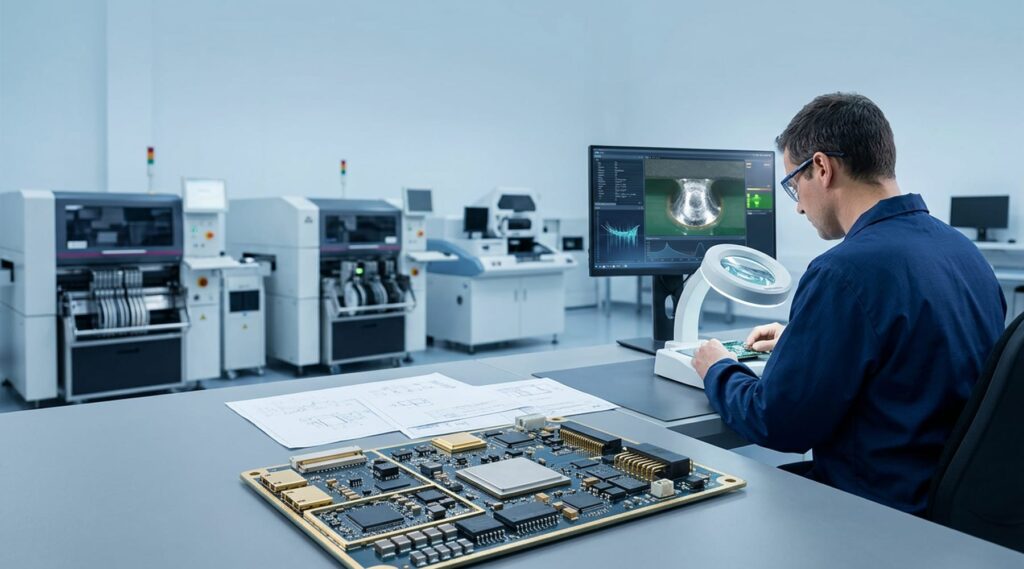
In aerospace electronics, an acronym like EMS often gets reduced to simple board assembly. For aerospace original equipment manufacturers, procurement managers, and systems engineers, the practical definition extends far beyond placing components on a circuit board. Electronic manufacturing services represent an integrated discipline designed to manage technical risk across the lifecycle of flight hardware and ground support systems.
Aerospace platforms operate in extreme thermal environments, withstand intense vibration profiles, and must maintain performance over extended lifecycles where field failures can jeopardize entire missions. When evaluating an electronics manufacturing partner, decision-makers must ask: What does EMS truly encompass for high-reliability aerospace projects? The answer lies in a practical responsibility map that systematically eliminates specific failure risks across every stage of production.
1. Rigorous Design for Manufacturability (DFM)
Early DFM analysis bridges the gap between theoretical electrical schematics and physical production realities. In an aerospace context, DFM involves an exhaustive review of copper geometries, solder mask clearances, thermal dissipation pathways, pad-to-trace ratios, and component spacing relative to automated pick-and-place equipment.
- The Concrete Work: Manufacturing engineers analyze Gerber and IPC-2581 datasets to identify acute copper angles, insufficient annular rings, via-in-pad thermal relief issues, and potential solder bridging vectors before raw laminates are cut.
- Failure Risk Reduced: Eliminates intermittent electrical opens, solder voiding under heavy thermal loads, and expensive revision respins. Catching layout issues at this juncture prevents defective boards from stalling assembly lines or failing during high-stress flight operations.
2. High-Precision Printed Circuit Board Assembly
PCB assembly for aerospace demand demands extreme process repeatability. Surface mount technology lines and selective through-hole soldering must maintain tight thermal profiles to prevent micro-cracking and intermetallic growth.
- The Concrete Work: Precise solder paste deposition monitoring, automated placement of fine-pitch components, and tightly controlled multi-zone reflow profiles tailored to board density and thermal mass. Specialized processes, including moisture-sensitive device handling and conformal coating, protect delicate assemblies from environmental factors.
- Failure Risk Reduced: Prevents cold solder joints, lifted pads, tin whisker proliferation, and solder joint fatigue caused by thermal expansion mismatches and mechanical shock during atmospheric exit or high-vibration maneuvers.
3. Electromechanical and Box-Build Integration
Mission-critical electronics rarely exist as bare boards; they function inside rugged enclosures, connected to sensor harnesses, power supplies, and avionics bays. Advanced EMS encompasses full box-build integration.
- The Concrete Work: Technicians route precision wire harnesses, integrate specialized thermal interface materials, install electromagnetic interference shielding, and torque mechanical fasteners to precise engineering specifications.
- Failure Risk Reduced: Mitigates wiring chafing, internal thermal throttling, enclosure seal degradation, and connector pin displacement. Precision assembly prevents mechanical misalignment from causing intermittent power drops during vibration profiles.
4. Multi-Layer Quality Inspection and Testing
Zero-defect objectives within an aerospace quality management system require inspection protocols that examine beyond surface aesthetics. Verification occurs at each manufacturing milestone rather than relying exclusively on final acceptance testing.
- The Concrete Work: High-resolution automated optical inspection verifies orientation, polarity, and alignment. Automated 3D X-ray inspection assesses hidden solder joints beneath ball grid arrays and quad-flat no-leads. Flying probe or in-circuit testing confirms electrical performance before functional testing simulates operational loads.
- Failure Risk Reduced: Uncovers subsurface voiding, microscopic bridging, internal trace fracture, and counterfeit component performance variances, preventing non-conforming units from escaping into downstream aerospace integration phases.
5. Traceability and Documentation Disciplines
Aerospace operations require absolute accountability. An EMS provider must furnish a complete digital paper trail for every component, operator touchpoint, and machine run.
- The Concrete Work: Building comprehensive device history records, validating certificates of conformance, recording lot-traceable component serial numbers, and maintaining calibration logs aligned with rigorous standards like AS9100D.
- Failure Risk Reduced: Removes audit exposure and regulatory grounding risks. If a component batch exhibits a known anomaly years after launch, complete lot traceability allows targeted containment rather than grounding an entire fleet.
6. Production Continuity and Supply Chain Management
Aerospace programs can span decades, making obsolescence management and supply chain resilience central to the EMS relationship.
- The Concrete Work: Proactive bill of materials scrubbing, tracking end-of-life notices, securing authentic components through authorized distribution channels, and managing buffer inventory strategies for long-lead-time active parts.
- Failure Risk Reduced: Prevents program delays driven by component obsolescence, protects against counterfeit electronic parts entering flight systems, and guards against production stoppages caused by volatile global supply dynamics.
Aerospace EMS Responsibility Matrix
When assessing electronic manufacturing services for flight programs, use this quick checklist to ensure your provider covers critical failure mitigation points:
- Engineering Handoff: Complete DFM, thermal relief verification, and mechanical clearance validation.
- Process Control: Monitored reflow profiling, calibrated selective soldering, and certified IPC Class 3 workmanship controls.
- Verification: 3D automated optical inspection, 2D and 3D X-ray analysis, and documented functional testing.
- Integrity and Compliance: Complete component lot-level traceability, counterfeit avoidance practices, and full device history record archiving.
- Lifecycle Support: Obsolescence tracking, engineering change order control, and long-term domestic support.
The Strategic Value of Domestic EMS Collaboration
For operations executives, procurement leads, and engineering teams, partnering with a high-reliability, U.S.-based manufacturing facility delivers operational visibility and intellectual property protection that offshore vendors struggle to replicate. Direct domestic communication eliminates technical latency, accelerates prototype-to-production transitions, and ensures close alignment with your quality engineering teams.
American Precision Electronics provides the technical sophistication, disciplined quality systems, and responsive domestic partnership required to keep aerospace and defense programs on schedule. Contact our engineering team today to review your bill of materials and explore how our domestic electronic manufacturing services can strengthen your mission-critical hardware builds.